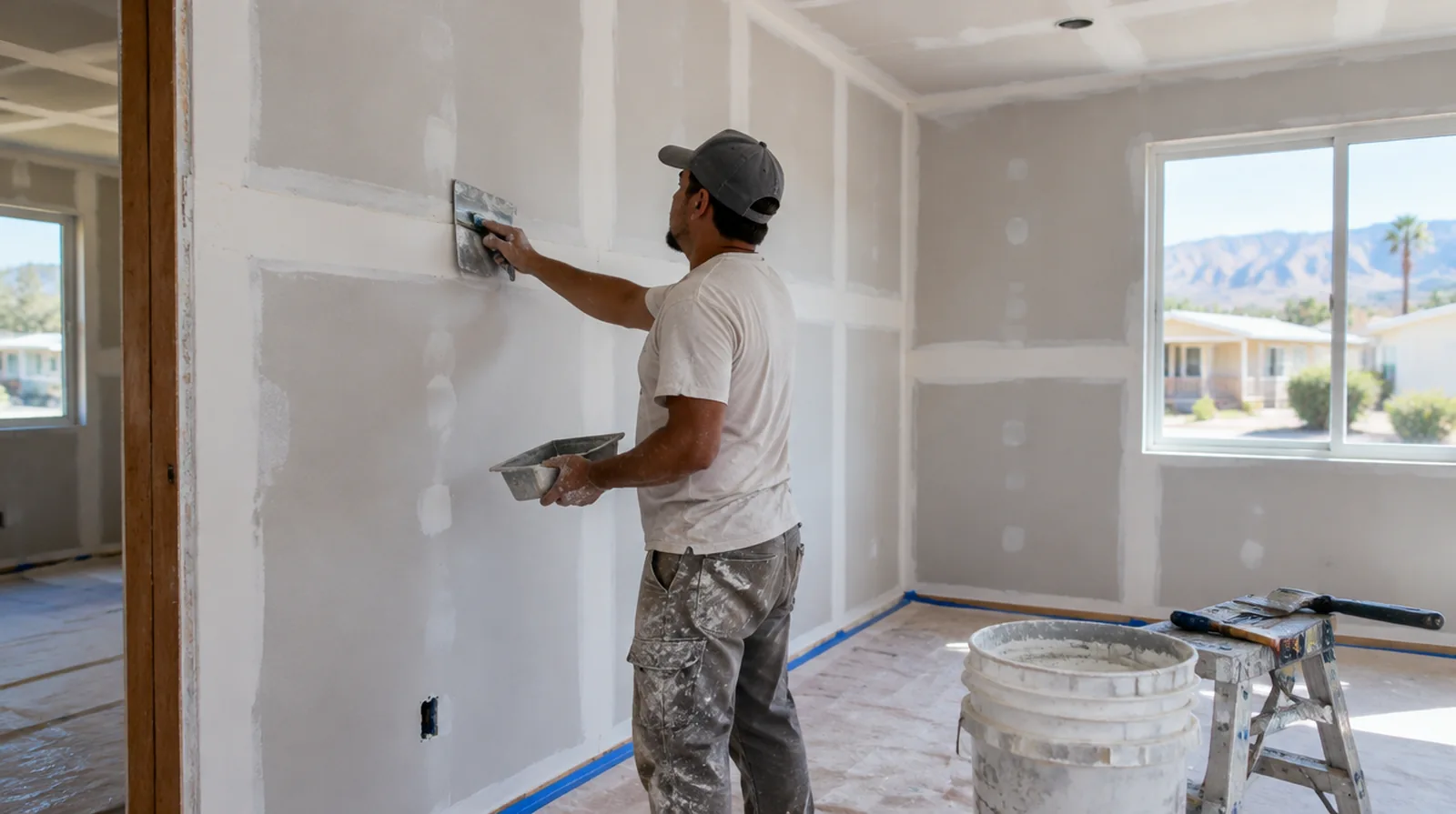
Valley heat and dry air
Summers in Hemet are hot and dry, often well above ninety degrees, and winters are cool with occasional frost at night. Long cooling seasons dry indoor air and can shrink fresh compound if coats are applied too thick. In a home where the air conditioning runs all day, cracks at ceiling corners and over doorways sometimes widen through summer and close again in winter, which helps separate seasonal movement from a structural concern.
Manufactured homes and single-story layouts
Manufactured homes in Hemet often use thinner gypsum panels, vinyl-covered boards or battens over the seams. Repairing them well can mean a different approach than standard half-inch drywall, sometimes replacing a whole panel rather than patching. In site-built single-story homes, the common jobs are cracks near sliding doors, water spots from evaporative coolers or roof leaks and dents in hallways. Sharing a photo of the wall surface helps decide the method early.
Hemet homes in the San Jacinto Valley
Hemet sits on the floor of the San Jacinto Valley beneath the San Jacinto Mountains, and much of its housing is single-story. Older neighborhoods around downtown and Florida Avenue have small postwar homes, while the west and south sides fill with 1980s and 1990s tracts and a large number of age-restricted and manufactured home communities. Walls are commonly sprayed with knockdown or orange peel, and many have been repainted over decades, which affects how a patch blends.
Before a scope is written
When panel replacement exposes a cavity, resolve any required inspection before that opening is closed and the finishing work begins.
When the history of a repair is uncertain, note when it became visible and whether its appearance has altered across different seasons.
Document recurring movement
Cracks that return after cosmetic repairs deserve a conversation about movement or moisture rather than another quick cover. A drywall estimate should state when another trade needs to investigate before surface work proceeds.
Fit corners and openings
Door returns and exposed corners require a straight consistent edge before the final compound coats are applied. Select the exposed edge profile for the design and the level of contact it will receive.
Discuss texture expectations
Determine whether the restored area should be smooth or carry an existing decorative pattern. A representative sample makes it easier to judge whether the current pattern can be blended locally.
Close out with clear limits
A final walk through should distinguish drywall corrections from paint, flooring and other trade work. Document any remaining items and the agreed handover condition before the work area is released.
Check underlying movement
A skim coat improves the surface profile but does not repair structural movement or unstable board. Recurring cracks should be investigated and reinforced appropriately before the finish is covered.
Account for side lighting
Windows and ceiling fixtures can expose shallow ridges once the heavy texture is gone. Broader finishing or a skim coat may be needed where the original surface was never intended to remain smooth.
About the illustrations
The website images are generated examples of drywall interiors and methods, not photographs of completed customer work. No customer reviews or qualifications are implied. The project form and the telephone shown on this page connect you with the next project conversation.
Explore the drywall services or view the address and map.
More planning details for Hemet
Manufactured homes in Hemet may use thinner or vinyl-covered panels, which can call for panel replacement instead of a patch. Many Hemet homes are single-story with sprayed knockdown walls that need a test patch before texturing the repair. Evaporative cooler leaks are a common source of ceiling stains in older Hemet homes.